
















 English (US)
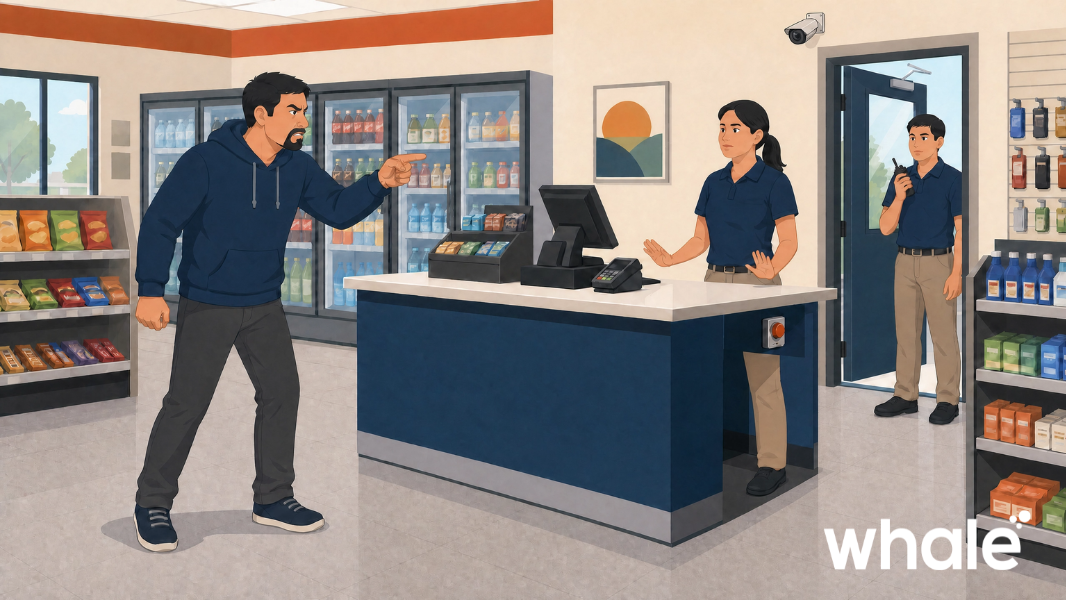
New York passed its Retail Worker Safety Act in September 2024. California's workplace violence prevention law took effect July 1, 2024. Since then, Connecticut, Illinois, Maryland, Minnesota, New Jersey, Oregon, Virginia, and Washington have all enacted similar statutes. Federal OSHA is developing the first national workplace violence prevention standard. State legislatures do not typically move this fast on labor protections. When they do, it usually means the underlying problem has become impossible to ignore.
The laws vary in specifics -- New York requires silent response buttons for employers with 500 or more retail employees; California mandates written prevention plans and annual training -- but they share a common diagnosis: retail workers are in a physically dangerous work environment, and employers have not done enough to address it. That diagnosis is correct.
The Data Behind the Legislation
A Traliant survey published in November 2025 found that 35 percent of retail workers reported feeling unsafe at work, up from 27 percent the year before. One in four said they had considered leaving their job specifically because of safety concerns. Among workers who had already experienced a violent incident, 53 percent said they were considering new opportunities. These are workforce stability numbers wrapped in a safety survey.
The NRF's 2025 report on theft and violence documented a 17 percent increase in threats or acts of violence against retail employees during shoplifting events between 2023 and 2024, and a 16 percent increase in incidents involving a weapon. Separately, the EHSLeaders workplace violence tracker recorded a 22 percent increase in physical assaults in the retail sector year-over-year. The CDC and NIOSH data situates this in a broader context: approximately 1 in 4 workplace homicides in the U.S. occur in retail settings -- the highest proportion of any industry.
"53% of retail workers who have experienced a violent incident are considering leaving their job. This is not a safety survey result. It is a workforce stability warning." -- Traliant Retail Workplace Violence Prevention Pulse Survey, 2025
The generational distribution is sharp and worth noting for workforce planning purposes: 38 percent of Gen Z retail workers have personally witnessed workplace violence in the last five years, compared to 13 percent of Baby Boomers. The workers who are newest to the industry, who represent the pipeline for future supervisors and store managers, are experiencing the most violent retail environment in recent history. Retention risk is concentrated exactly where talent pipeline risk is concentrated.
What the Laws Get Right -- and What They Leave Out
The new state laws are necessary. Written prevention plans create accountability. Training requirements ensure staff have a baseline response protocol. Silent response buttons give workers a way to summon help without escalating a confrontation. These are meaningful improvements over the prior standard, which was essentially nothing.
What they cannot mandate is earlier detection. A silent button that alerts a manager is useful once a situation has already escalated to the point where a worker can safely reach for it. The window that matters most -- between the first signs of agitation and the point of confrontation -- is not addressed by any current legislative framework. That window is where AI operates.
Earlier Detection Is a Different Kind of Protection
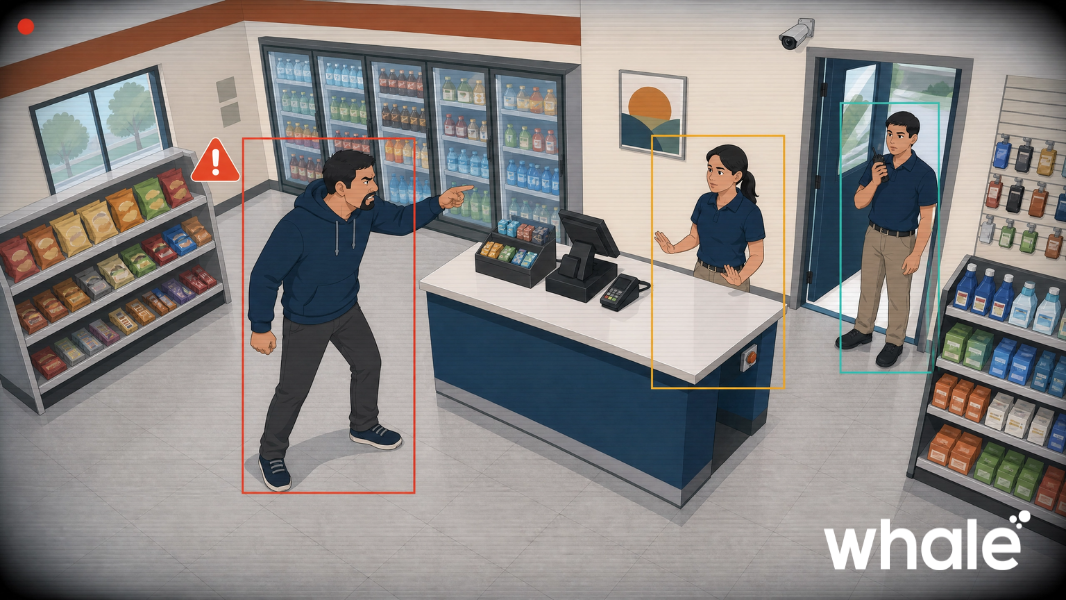
Most violent retail incidents do not begin without precursors. A customer enters in an agitated state, raises their voice, moves toward a staff member. Those behavioral signals are visible in real time on any camera feed. The problem is not that the cameras are not watching -- it is that nobody is watching 40 cameras simultaneously, continuously, without fatigue.
A Vision Language Model running on existing camera infrastructure changes this. It monitors every zone, continuously, trained to recognize behavioral signatures that precede escalating situations: aggressive posture, rapid approach toward staff, crowd formation around a conflict point. When patterns match, an alert routes to security and management before the situation escalates -- not a button pushed mid-confrontation, but a proactive heads-up while there is still time to intervene safely.
The retention math reinforces the safety case. Average replacement costs for retail workers hit $36,723 to $45,236 per employee in 2025-2026 data, factoring in recruiting, onboarding, and the performance ramp. At a 60 to 75 percent annual turnover rate, with safety now cited as a primary driver of voluntary departures, the cost of leaving this problem to legislation alone is a compounding operational expense. Compliance meets the legal floor. Proactive detection raises it.
Whale's SpaceSight monitors every zone in real time, routes AI-flagged behavioral alerts before situations compound, and runs on your existing camera infrastructure. One LP team using SpaceSight can cover 50 locations with the consistency that manual monitoring cannot sustain.
Referenced in this article
Traliant -- The Retail Report: Workplace Violence Prevention Pulse Survey 2025: traliant.com/resources/the-retail-report-workplace-violence-prevention-pulse-survey/
EHSLeaders -- Measuring the Impact of Workplace Violence on Retail Staff and Retention: ehsleaders.org/2025/11/measuring-the-impact-of-workplace-violence-on-retail-staff-and-retention/
Allwork.space -- Over Half of U.S. Retail Workers Considering Quitting Over Safety: allwork.space/2025/11/over-half-of-u-s-retail-workers-now-considering-quitting-over-safety-fears/
NRF -- The Impact of Retail Theft & Violence 2025: nrf.com/research/the-impact-of-retail-theft-violence-2025
Ogletree -- States Ramp Up Workplace Violence Prevention 2025: ogletree.com/insights-resources/blog-posts/states-ramp-up-workplace-violence-prevention-efforts-with-new-legislation-in-2025/
Littler -- New York Retail Worker Safety Act: littler.com/news-analysis/asap/new-york-proposes-chapter-amendment-retail-worker-safety-act-including-sweeping
Capital Analytics -- Why Turnover Costs More in 2025: capitalanalyticsassociates.com/why-turnover-is-costing-your-business-more-and-how-to-fix-it/
CDC/NIOSH -- Violence and Work: cdc.gov/niosh/violence/about/index.html
- AI Retail Loss Prevention: Why $90 Billion in Annual Shrink Demands a New Approach
- Retail Workplace Violence Prevention: What AI Catches Before Panic Buttons Help
- The $9 Billion OOH Attribution Gap: Why Physical Ad Spend Still Runs on Faith
- In-Store Retail Media Measurement: Why 84% of Sales Happen Where 1% of Ad Spend Goes
- Energy, Passion, and the Future of AI
- Check Out Whale's Open Space, Where AI Meets the "Lead to Win" Spirit
- Introducing Echo
- Whale Secures $60 Million to Expand its Enterprise AI Suite Globally
- 3 Ways to Improve Conversion Rate for the Automotive Industry
- How SpaceSight Works in Standardizing and Improving Operational Efficiency for Car Workshop
- How GXG Leveraged Footfall Analytics for Smarter Employee Management
- From Browsing to Buying: Use SpaceSight to Optimize Sales Through Product Placement
- How GIORGIO ARMANI Redesigned Success Metrics Across Multiple Stores
- How Supermarket Chains Improve Inspection Efficiency with Smart Technology
- Four Management Practices to Ensure Food Safety in Your Kitchen
- How SpaceSight Improved Inspection Efficiency for Chain Restaurants
- Build Consistent Customer Dining Experience with SpaceSight Onsite Inspection
- How to Use Footfall Analytics to Improve Customer Service
- Navigating the Future of Retail with AI with OPPO Indonesia
- Why Retail Managers Need Inspection Software for Store Management











-
 Schedule a demoProfessional consultants will provide a brief explanation lasting at least 20 minutes to help you evaluate and use Weve products more efficiently. Please leave your contact information, and we will contact you as soon as possible to schedule a demonstration time.
 -
 Scan to followStay updated with the latest news anytime, anywhere
 Whale Instagram Page
 Whale Linkedin Page
 -
 Customer Service CenterProvide one-on-one consultation and technical support for products and solutions
-
 Back to top